

I often get asked about hallmarks. What are they? And how do I read them? Every country has their own take on hallmarks so they will look different from country to country. The rings you will find on OldMine are mostly Swedish, English and Danish but in Denmark we don’t have much tradition for elaborate hallmarks. So I will focus on the English hallmarks and explain how they work.
Hallmarks can be traced back to 1238 when the first standards of gold and silver quality were officially laid down. The beginning of the hallmarks as we know them today dates back to 1300 and was introduced by a statute of Edward I, where it was declared that no piece of silver ‘was to depart out of the hands of the workers’ until it had been assayed (tested) and marked with a leopard’s head’.
How to read a hallmark
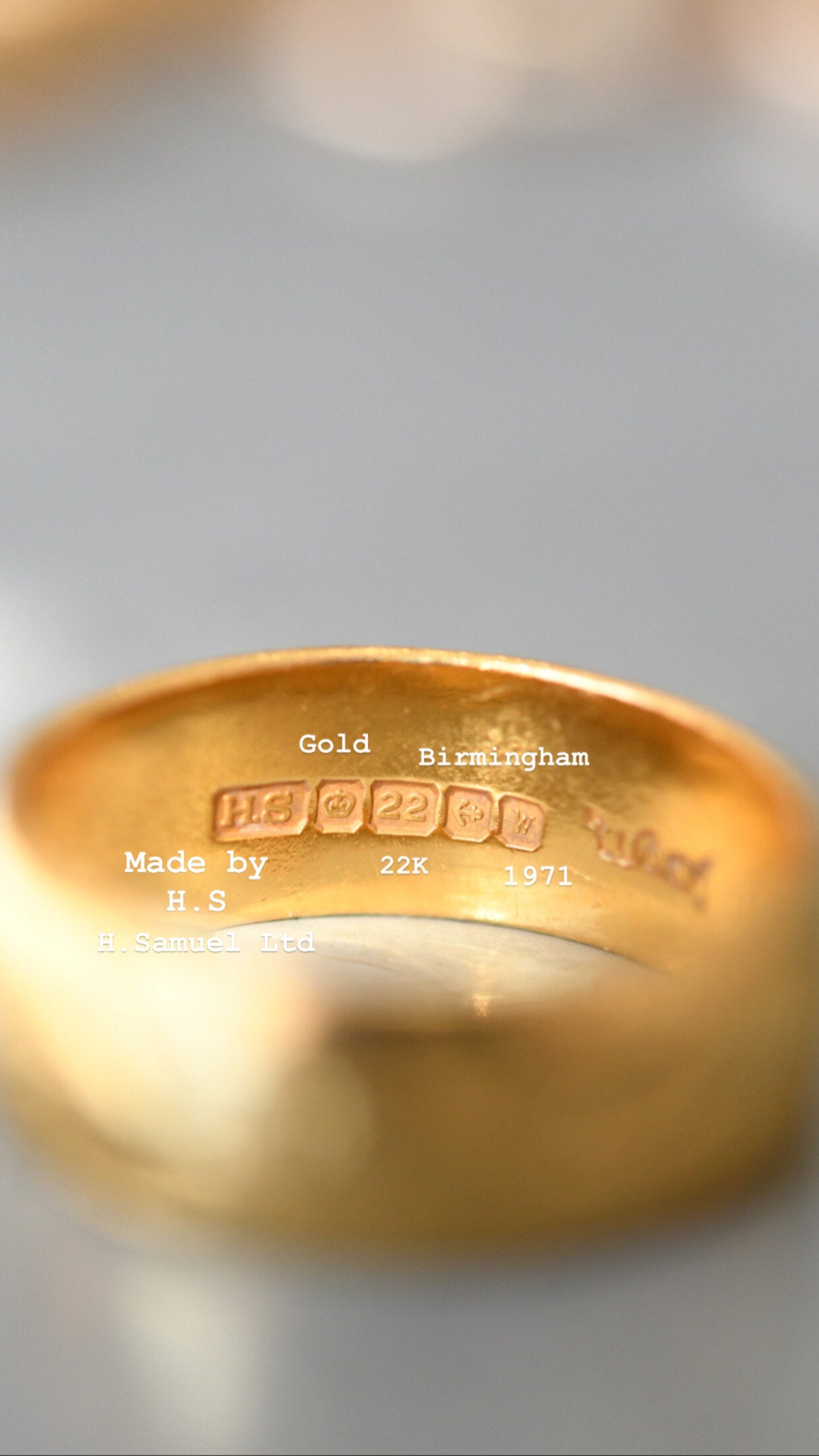
Hallmarks are really a proof of the origin, fineness and age of your jewelry. But you can read a few more things out of the hallmarks that consists of:
Initial mark: Who made the article? You will find initials like fx H.S. This mark can be looked up since most goldsmiths have been registered.
Traditional mark: What kind of metal is it? You will see a crown for gold, a lion for silver etc. This mark is not always present.
Fineness mark: What carat is it? The higher the number, the higher the carat (can be numbers like fx 18, 22 but can also say 750 for 18K and 916 for 22K etc.).
Assay Office mark: Where was the piece tested and marked? There are four assay offices still working in Britain: London, Birmingham and Sheffield in England, and Edinburgh in Scotland (other offices have existed but are now closed). Each have a different symbol like an anchor for Birmingham.
Date letter: When was the piece made? Each year has a letter. This mark must be read together with the office mark since they are correlated, and with the typeface and the shape around the letter, because every office ran its own cycles.
Since 1975 the date letter has changed on January 1st and all the offices share one cycle. Before that each office changed its letter on its own new year in the middle of the calendar year, which is why older tables are written as 1882-83 rather than as a single year. For example, Q = 2015, R = 2016, S = 2017. From here, you can work out how old the piece will be. Each new cycle of alphabets is written in a different font with a different shape around, so it is easier to date. You might need a loupe to see the details.
Where do I find a list over hallmarks?
On the website Silvermakersmarks.co.uk you can easily search for hallmarks . The site says that you can find marks on English and Irish Silver but this applies to gold as well.
Do all antique and vintage pieces have hallmarks?
No, not all pieces are hallmarked. That doesn’t mean that they are not old, genuine, fine etc. It means that they can be more difficult to date correctly and need to be tested for gold fineness by the seller. And you need to trust the sellers ability to both date and test.
So it IS nice, especially for a buyer, when pieces are hallmarked cause you can date the pieces accurately by your self. But not all goldsmiths in history (or now) have had a tradition of sending their pieces to an assay office to get marked so you will meet plenty of pieces that are not marked. In Denmark for example they don’t have much tradition for hallmarks.
Where to read more
If you are curious about hallmarks, both from England and other countries, I will recommend that you read more on the official site of hallmarks.
Hugs , Line
Frequently asked questions
What do the symbols in an English hallmark mean?
A full English hallmark combines a standard mark for the metal fineness, a town mark for the assay office, a date letter for the year, and usually the maker's initials. Together they tell you what the piece is, where it was tested and when.
What does the leopard's head hallmark mean?
The leopard's head is the town mark of the London assay office, in use since 1300. It is one of the oldest continuously used marks in the world.
How do I date English jewelry from the hallmark?
Find the date letter and compare it against the assay office's table. The letter, its font and the shape of the shield around it together give you the exact year, which is why the same letter can mean different years in different cycles.
What is the monarch's head on English silver and gold?
A duty mark, showing that tax had been paid on the piece. It was used from 1784 to 1890, so its presence alone dates a piece to that window.
Is unmarked English jewelry fake?
Not necessarily. Small and lightweight items were often exempt from hallmarking, and marks wear away or disappear during resizing. Judge the construction and have the metal tested rather than assuming.
